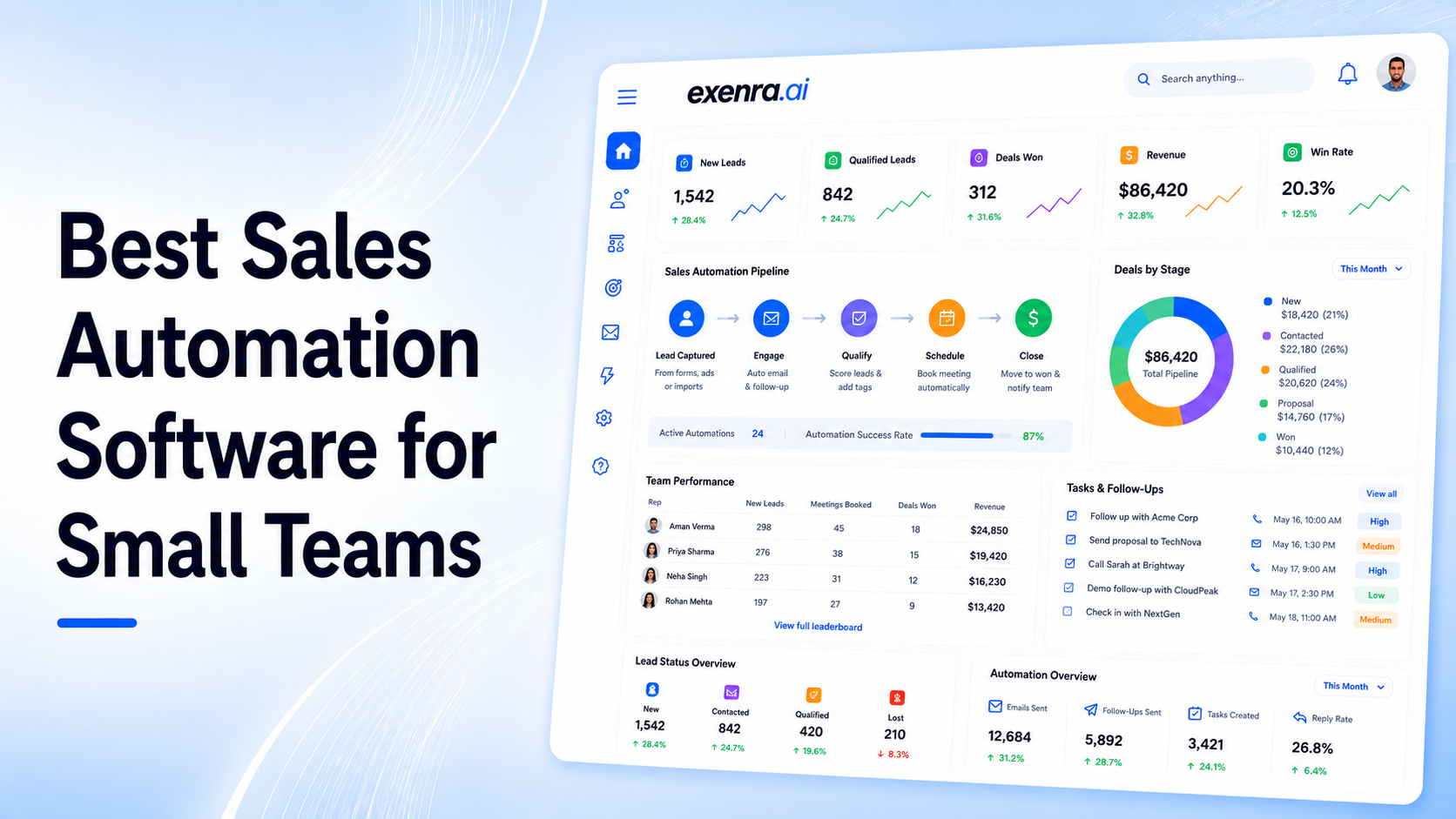
Most small sales teams don’t fail because they lack leads.
They struggle because their sales process is not structured.
Leads come in from ads, social media, websites, and referrals. But instead of being handled in a proper system, they are scattered across tools, inboxes, and team members.
Some leads stay in WhatsApp chats, some in spreadsheets, and some are simply forgotten.
The result is simple: opportunities are lost not because they didn’t exist, but because they were not managed properly.
This is where sales automation software becomes essential for small teams.
What Sales Automation Software Actually Means
Sales automation software is a system that helps businesses manage their entire sales process with less manual work.
Instead of doing everything manually, the system helps you:
Capture leads automatically
Assign leads to team members
Send follow-up reminders
Track deal progress
Organize sales activity
Reduce manual work and errors
The goal is simple: better structure, faster response, and higher conversions.
The Real Problem Small Sales Teams Face
Small teams usually don’t have separate roles for every part of the sales process. One person often handles everything.
This creates serious challenges:
Slow response time
Leads are not answered quickly, which reduces conversion chances.
No clear ownership
It is often unclear who is responsible for each lead.
Missed follow-ups
Many deals are lost because follow-ups are forgotten.
No visibility
Managers cannot see what is happening in the pipeline.
Scattered data
Information is spread across different tools and platforms.
Why Sales Automation Is Important in 2026
Today’s customers expect fast responses and smooth communication.
If they don’t get a reply quickly, they move to a competitor.
Sales automation ensures:
Instant lead response
Consistent follow-ups
Clear ownership of leads
Structured sales pipeline
Better visibility for managers
Improved conversion rates
Types of Sales Automation Software
CRM Platforms
Used for managing customer data and tracking deals.
Examples: HubSpot, Salesforce, Pipedrive
Prospecting Tools
Used for finding and collecting new leads.
Examples: Apollo.io, Clay
Workflow Automation Tools
Used for connecting apps and automating tasks.
Examples: Zapier, Make, n8n
AI Sales Tools
Used for outreach and messaging automation.
Examples: Regie.ai and similar tools
Each tool solves only part of the problem.
Comparison of Popular Sales Automation Tools
Tool | Best For | Strength | Limitation |
|---|---|---|---|
Salesforce Sales Cloud | Large enterprises | Advanced CRM and forecasting | Too complex for small teams |
HubSpot Sales Hub | SMBs | Easy CRM and tracking | Can become expensive |
Pipedrive | Small teams | Simple pipeline management | Limited automation |
Apollo.io | B2B outreach | Large contact database | Not a full CRM |
Clay | Lead enrichment | AI-based research | Technical setup required |
Zapier | App automation | Connects thousands of apps | No lead management |
Regie.ai | AI messaging | Outreach automation | Not full sales system |
Exenra.ai | Sales automation + tracking | Full lead lifecycle management | Focused on SMB workflows |
The Main Gap in Most Sales Tools
Most tools only solve one part of the sales process.
Zapier connects apps
CRMs store data
Prospecting tools find leads
AI tools generate messages
But small teams need a complete system that includes:
Lead capture
Assignment
Follow-ups
Pipeline tracking
Team visibility
Performance reporting
Without this, businesses end up using too many disconnected tools.
What a Complete Sales Automation System Should Do
A proper system should support the entire sales journey:
Lead capture
Automatically collect leads from ads, websites, and social platforms.
Lead assignment
Assign leads to the right team member instantly.
Follow-up automation
Ensure no lead is forgotten or ignored.
Pipeline tracking
Show exactly where each deal stands.
Team tracking
Monitor who is handling what.
Reporting
Track performance, conversions, and lead sources.
Manual vs Automated Sales System
Manual Process | Automated System |
|---|---|
Leads in spreadsheets | Centralized dashboard |
Slow responses | Instant notifications |
Missed follow-ups | Automated reminders |
No ownership clarity | Clear assignments |
Hard to scale | Easily scalable |
Low visibility | Full tracking |
Why Exenra.ai Is Different
Most tools are built for either automation or CRM.
Exenra.ai focuses on the full sales process.
It is designed for small teams that need clarity, speed, and structure.
What it helps with
Centralized lead capture
Automatic lead assignment
Follow-up management
Sales pipeline visibility
Team performance tracking
Example Sales Workflow
Lead comes from Facebook ad
System captures it instantly
Lead is assigned to a sales rep
Notification is sent
Follow-up task is created
Pipeline stage is updated
Final result is recorded
Benefits of Sales Automation for Small Teams
Faster lead response
Better organization
Higher conversion rates
Improved team accountability
Reduced manual work
Clear sales visibility
Easier scaling
Final Conclusion
Sales automation is no longer optional for small teams.
It is a core system that determines how efficiently leads are handled and converted into customers.
While tools like Zapier, HubSpot, and Apollo solve individual parts of the process, they do not provide a complete sales lifecycle system.
Modern businesses need a unified approach that includes:
Lead capture
Assignment
Follow-ups
Tracking
Reporting
This is where platforms like Exenra.ai become valuable.
FAQs
What is sales automation software?
Sales automation software is a system that automates lead management, follow-ups, pipeline tracking, and sales processes to improve efficiency and conversions.
Is Zapier a sales automation tool?
Zapier is a workflow automation tool, not a full sales management system. It connects apps but does not manage leads or pipelines.
What is the best sales automation software for small teams?
Popular options include HubSpot, Pipedrive, Salesforce (for larger teams), and Exenra.ai for full sales workflow automation.
Why do small teams need sales automation?
Small teams often lose deals due to missed follow-ups, slow responses, and lack of structure. Automation fixes these issues.
Can sales automation increase sales?
Yes. Faster responses and consistent follow-ups significantly improve conversion rates.
What is the difference between CRM and sales automation?
CRM stores customer data, while sales automation actively manages workflows like assignments, follow-ups, and pipeline movement.
Can Exenra.ai replace multiple tools?
Yes. For many small teams, it can reduce the need for separate CRM, follow-up tools, and tracking systems.
Do I need technical skills to use sales automation software?
No. Most modern tools, including Exenra.ai, are designed for non-technical users.
Start your 7-day free trial with Exenra.ai and automate your first lead workflow without coding, Zapier, or an expensive CRM.